


1
Memo type
DeepSeek



This page explains Curator Interpreters for the person who designs the process — analyst, coordinator, business owner. You do not need to know how to program. Whenever a screen name appears, it is translated right there, with an everyday analogy. The animations play on their own: hover to pause and click to watch again.
Think of a cooking recipe. You gather the ingredients, follow the preparation in stages, and at the end you have a finished dish. In Curator, that recipe is called an interpreter.
You hand over a piece of information. It goes through one or more reading stages, one after another. At the end, you receive a result ready to use — in an automation, in a test, or in AI Chat.
The idea is simple: separate the job of understanding a piece of information from the rest of the process. Instead of hiding the request to artificial intelligence inside each automation, you concentrate that knowledge in a named recipe with history and measured cost.
Use it when the stage involves understanding language or images — not just applying a rule that never changes.
There are five ideas. It is worth knowing each one before opening the screen.
| Name | In plain language |
|---|---|
| Recipe (interpreter) | The complete package: name, steps, and what it needs to receive. |
| Step | One reading stage. It has a title, a written request, and the artificial intelligence model that runs it. |
| Input | What you provide when using it. It can be text or an image. On screen it appears as input. |
| Request | The plain-language text that tells the artificial intelligence what to do. The screen calls this an instruction. |
| Result | The output of the last step. Always text. The format is whatever you asked for in the request. |
When you open a recipe, the center of the screen is a left-to-right diagram. Each numbered box is a step. The arrows show the order. A step can reuse another step’s result — that draws an arc above the flow.
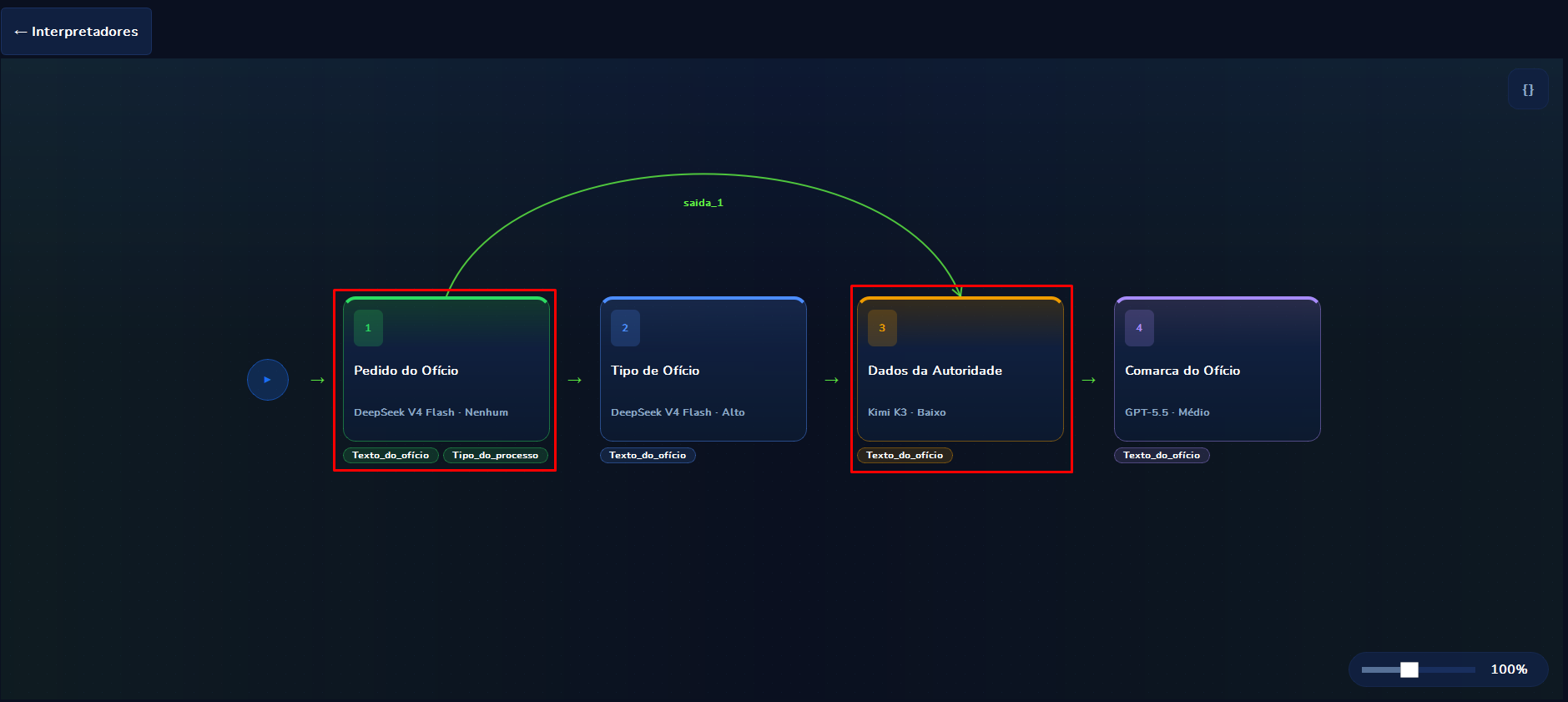
On the real screen you see the same idea as the animation: boxes with the step name and chosen model, tags for what each stage receives, and the arc when a result is reused.
In each step you set four things: a short name (e.g. “Extract tax ID”), the artificial intelligence model, what goes in to that step, and the request. The source of what goes in can be you (at run time), the previous step’s result, or the result of a specific earlier step.
The request is plain-language text. On screen the field is called an instruction. A well-written request usually has four blocks:
That place in the text looks like this: {{oficio}}. It is the slot in the request. If the information is named oficio, you put {{oficio}} at the exact point where the text should go. Below the field, the screen shows name tags — click to insert the correct format.
{{name}} in the text. Then the value is collected but never reaches the artificial intelligence. Curator flags the step with the Input outside the prompt warning.
On the diagram, the run button opens the window for what goes into the recipe. You declare what the recipe requires, paste an example value, and click Run in flow. Examples are kept for the next test.
During the run, each box goes through Processing, Completed, or Failed. When the round finishes, click each step’s result to see that stage’s text. That way you find the exact point where information was lost — without guessing from the final answer alone.
Under Monitor in the recipe list sits the history: date, success or failure, which recipe ran, and estimated cost. The provider charges by amount of text, measured in tokens — pieces of a word. The number in Curator is an estimate for comparing and projecting scale; real billing is directly with the provider, using your access key.
In the Interpreters module you create, test, and maintain the recipe — and anyone on the team can run a one-off case. In AI Chat you can ask to list, create, adjust, or run a recipe through the conversation. In automations, the robot handles the clicks and delegates understanding to the recipe.
(not_found). Without a rule, artificial intelligence tends to invent.{{name}} in the request. Without the slot, registered information never reaches the artificial intelligence.